


 로그인을 해주세요
-
Assessment of Neurologic function
1) Central nervous system (CNS, 중추신경계)
- Brain and Spinal cord
2) Peripheral nervous system (PNS, 말초신경계)
- Cranial nerves (뇌신경)
- Spinal nerves (척수신경)
- Autonomic nervous system (자율신경계)
→ Sympathetic/parasympathetic nervous system
2. Major Sections of Brain
1) Cerebrum (대뇌)
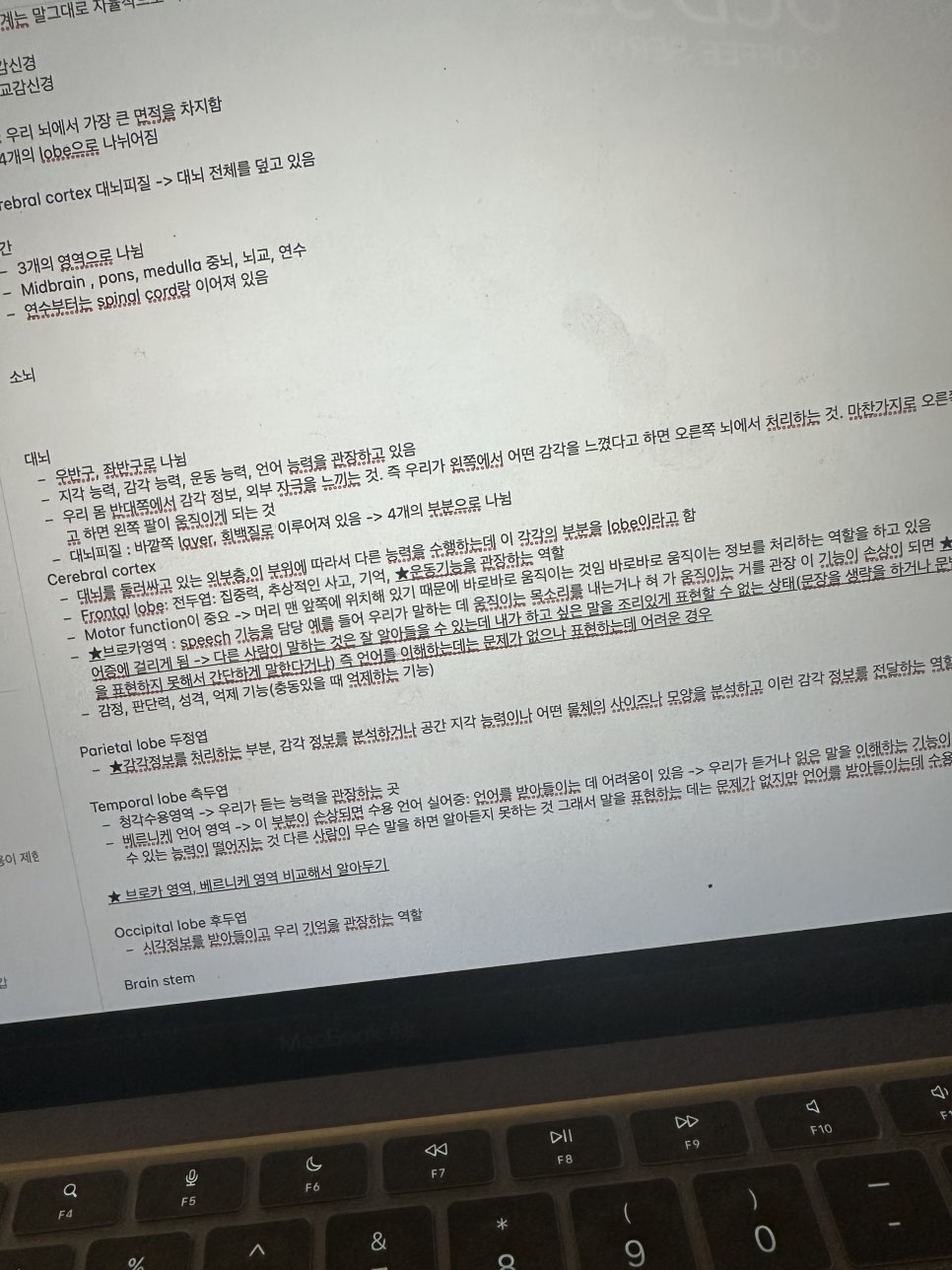
- The largest part of the brain; Right and left hemisphere 뇌에서 가장 큰 부분을 차지하고 우반구, 좌반구로 이루어져 있음
- Responsible for cognition, sensory perception, voluntary motor control, and language
지각, 인식, 감각, 운동조절, 언어 등을 담당함
- Receive sensory input from the body's opposite side and are in charge of coordinating the skeletal muscles on the opposite side.
예를 들어 오른쪽 뇌에서 팔을 움직이라고 명령을 내리면 왼쪽 팔을 움직이게 됨
- Cerebral cortex : the outer layer of the brain (gray matter, 회백질)
↓
Divided into 4 lobes
① Frontal lobe (전두엽)
- Concentration, abstract thoughts, memory and motor function,
★Broca's area (speech; expressive aphasia, 운동성(표현성) 실어증), Person's affect, judgement, personality and inhibition
② Parietal lobe (두정엽)
- Analyzes sensory information, relays the interpretation to other body positions in space, size and shape
③ Temporal lobe (측두엽)
- Auditory receptive area, ★Wernicke's area (receptive aphasia, 수용언어 실어증)
④ Occipital lobe (후두엽)
- Visual interpretation and memory
2) Brain stem (뇌간, 뇌줄기)
① Midbrain(중뇌)
- The uppermost part; coordinates visual and auditory reflexes, eye movement, and the regulation of arousal and wakefulness
② pons(뇌교)
- Plays a role in controlling breathing, posture, sleep, and facial movements
③ Medulla oblongata (연수)
- The lowest part of the brainstem
- Regulates breathing, heart rate, blood pressure
- Controls reflexes like swallowing, coughing, and sneezing.
3) Cerebellum (소뇌)
- Posterior to the midbrain and pons; below the occipital lobe
- Integrates sensory information to provide smooth coordinated movement
- Responsible for fine movement, balance and position (postural sense)
- Assessment
→ Assessment of gait and balance
→ Finger-to-nose test
→ Rapid alternating action
3. Structures of the Neurologic System
Peripheral nervous system (PNS)
- Cranial nerves (뇌신경) : Total 12 pairs -> 무조건 암기!!!!!
1. Olfactory nerve (후각신경)
2. Optic nerve (시신경)
3. Oculomotor nerve (동안신경)
4. Trochlear nerve (활차신경)
5. Trigeminal nerve (삼차신경)
6. Abducens nerve (외전신경)
7. Facial nerve (안면신경)
8. Vestibulocochlear nerve (전정와우신경)
9. Glossopharyngeal nerve (설인신경)
10. Vagus nerve (미주신경)
11. Accessory nerve (부신경)
12. Hypoglossal nerve (설하신경)
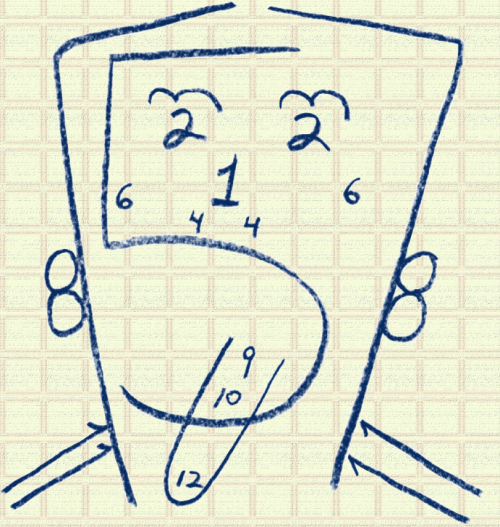
이 방법이 젤 외우기 쉬움!
- Spinal nerves (척수신경) : Total 31 pairs (8 cervical, 12 thoracic, 5 lumbar, 5 sacral, 1 coccygeal nerves)
- Autonomic nervous system (자율신경계)
→ Sympathetic nervous system: Fight or flight response
→ Parasympathetic nervous system: Visceral functions
4. Neurological diagnostic Tests
1) CT (computed tomography) : 전산화 단층촬영
▶ Purpose
- Detects hemorrhage, intarction, abscess, tumors, hydrocephalus and brain herniation
- May or may not require IV contrast dye
▶ Preparation
- Informed consent
- Painless procedure, immobile during exam
- Patient education - contrast dye may cause flushing in the face and metallic taste during injection
얼굴이 붉어지는 이유는 조영제가 혈관을 일시적으로 확장시켜 나타나고
조영제 주입 후 metallic taste가 나타나는 것은 조영제가 혈액을 통해 미각신경을 자극해서 나타난다고 함
(나의 백과사전 췟지퓌뤼가 알려줌...ㅎ)
▶ Nursing considerations
- Assess for allergic reactions to contrast dye: 조영제 알레르기 과거력, 조개/갑각류 알레르기 유무 여부 학인
→ allergic reaction: 숨가쁨, 두드러기, 심한 가려움, 목이 조이는 느낌
- Encourage fluid intake after exam
: CT에 사용하는 조영제 대부분은 신장을 통해 배설되기 때문에 조영제를 빠르게 배출하기 위해서 fluid intake를 늘려야 함
2) Cerebral Angiography : 뇌혈관 조영술
▶ Purpose
- Detects aneurysms, vascular malformations, narrowed vessels by injection of contrast medium
▶ Preparation
- Informed consent
- Assess for shellfish or iodine allergy and kidney function
- Patient education - contrast dye injection into femoral artery; fluoroscopy and radiologic films taken after the injection
- Anticoagulation : femoral artery로 조영제가 주입되기 때문에 항응고제 복용 여부 확인해야 함
▶ Nursing considerations
- Assess for allergic reactions to contrast dye
- Encourage fluid intake after exam
- ★ Keep patient flat in bed 12 hours
: 뇌혈관 조영술은 대퇴동맥으로 카테터를 넣기 때문에 몸을 일으키면 대퇴동맥 압력이 증가하여 출혈 위험이 높아짐
- ★ Check the puncture site for hematoma
: 혈종은 혈관 밖으로 나온 혈액이 피부 아래에 고여서 생기는데 이것은 지혈이 잘 안되고 있다는 의미
- Perform neurological assessment
3) Lumbar puncture (LP) : 요추 천자
▶ Purpose
- Needle inserted into subarachnoid space to obtain CSF or inject dye or medications
- Contraindicated to high ICP patient
: 뇌척수액은 뇌와 척수 주변 압력을 일정하게 유지하는 역할을 함
: 그런데 ICP가 이미 높은 상태에서 lumbar에서 CSF를 갑자기 빼면 척수 쪽 압력은 낮아지고 두개강 압력은 그대로 높아 압력 차이가 생겨
뇌가 아래쪽으로 밀림 ⇒ brain herniation (뇌탈출)
▶ Preparation
- Informed consent
- Lateral recumbent or fetal position 옆으로 쪼그리고 누운 자세 또는 태아형 자세
▶ Nursing considerations
- Perform neurological assessment
- Position flat for 4-5hrs : CSF 누출을 줄이고 두통을 예방하기 위해서
- Monitor for headache
- Encourage fluid intake
- Monitor bleeding or CSF leakage at the insertion site → Halo sign
Halo sign : 혈액이 섞인 체액이 고리모양(halo)으로 퍼져 보이는 현상
(CSF는 물처럼 맑고 혈액보다 퍼지는 속도가 빨라 혈액은 중심에 남고 CSF는 주변으로 퍼짐)
4) Electroencephalogram (EEG) : 뇌파검사
▶ Purpose
- Records electrical activity of brain
▶ Preparation
- Patient education - painless exam
- Avoid sedatives or stimulant before exam
- Avoid stimulants (caffeine, coke, tea, cigarettes) before exam
▶ Nursing considerations
- Withhold prescribed medications before EEG (ex. antiepileptics, sedatives, hypnotics)
- Help patient wash paste from hair
- Monitor for seizure activity
5) MRI (Magnetic resonance imaging) : 자기공명영상
▶ Purpose
- Identifies tissues, tumors, and vascular abnormalities
- May or may not require contrast dye
- Provides more detailed images than CT
▶ Preparation ★ Safety ★
- ★ Remove all metal objects from the patient
- MRI Checklist: Verify whether the person has a pacemaker, implanted defibrillator, or any metal implants such as a cochlear
implant, hip prosthesis, or vascular clips
- IV extension - IV pump should stay outside of the MRI room
- Assess for claustrophobia(밀실공포증) and administer prescribed medication accordingly.
- Patient education - contrast dye injection; should lie still during the exam
[문제/케이스 풀이]
Q. The nurse is caring for a patient with a cerebellar deficit. Which of the following observations should the nurse anticipate after conducting a neurological assessment? Select all that apply.
A. The patient is unable to swallow water.
B. The patient is unable to walk heel-to-toe.
C. The patient is unable to gaze at and track the moving fingers of the providers.
D. The patient is unable to touch his nose and the nurse's finger alternately.
풀이
: Cerebellum = 균형 + 협응 + 정확한 움직임 조절
A. The patient is unable to swallow water. → 삼킴은 주로 뇌간(brainstem), 특히 연수(medulla) 기능으로 소뇌 문제와 직접 관련 없음
B. The patient is unable to walk heel-to-toe. → heel-to-toe walking은 대표적인 소뇌 기능 검사로 소뇌 손상 시 균형 못 잡고 비틀거림
C. The patient is unable to gaze at and track the moving fingers → 눈 움직임 추적은 주로 뇌간
D. The patient is unable to touch his nose and the nurse's finger alternately.
→ finger-to-nose test은 대표적인 소뇌 기능 검사로 소뇌 손상 시 목표 지점 정확히 못 맞추며 떨림이 나타남
정답 : B, D
7주차 공부후기)
벌써 7주차라니!! 시간이 굉장히 빨리 간다. 그.러.나. 아직 들을 강의, 할 공부는 아직도 많이 남았다는 거....흑
이번주는 훅 뛰어넘어서 목차 거의 마지막에 있는 신경계 공부를 했다. 요즘 중환자실에서 hemorrhage 환자들도 너무 많아서 공부할 필요성을 느꼈다... 항상 느꼈지만 이제는 공부 안하면 안될 것 같은 느낌쓰.. 이번주 초반에는 fundamentals를 끝내고 그제?부터 신경계 들어서 아직 초입만 공부했지만 다음주까지 한번 잘 끝내보겠다... 엔클렉스 공부하면서 진짜 알아가는 것들이 굉장히 많고 실제 임상이랑 엮어서 생각하면 더 이해가 잘 된다. 모든지 실제 경험이 중요하다는 말이 무슨 말인지 이해가 간다.. 다음주는 신경계 질환에 대해서 깊이있게 공부할 것 같은데 담주는 더 빡시게 공부해보겠다!!!🔥🙂
[출처] https://blog.naver.com/abcdefggon/224250051015


통신판매업신고번호 : 2024-서울서초-0152 | 출판사등록번호 : 제2019-000285호 | 개인정보관리책임자 : 김진선
주소 : 서울특별시 서초구 논현로31길 41, 5층(양재동, 세원빌딩) | 이메일주소 : dreamnurse7@naver.com
문의사항 : 드림널스 홈페이지 우측 하단 채널톡 문의 또는 카카오톡 채널 드림널스 문의 Copyright (c) 주식회사 드림널스 All Rights Reserved.
호스팅 제공자: 주식회사 맑은소프트