닫기
과정 구분
과정 카테고리
태그
검색어

수강/합격 후기

수강후기 헷갈리는 내용들만 정리

  • 작성자eong**
  • 작성일2026.04.19
  • 조회수6
  • 신고하기

Voiding dysfunction / Disorders of Urinary Track

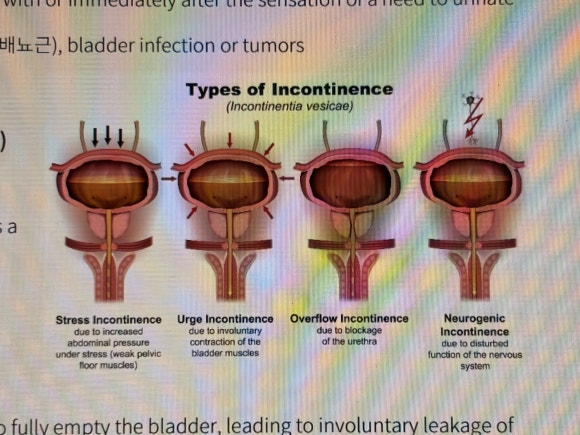
1. Incontinence(실금)

종류

설명

Stress

Urge

overflow

Neurogenic

Functional

eg. Dementia, Immobility

Enuresis

  • Bed-wetting in a child at least 5 years old

  • Nocturnal overactivity of the detrusor muscle

Nursing interventions for incontinence

  • Lifestyle changes - weight loss, reducing caffeine intake and avoiding constipation

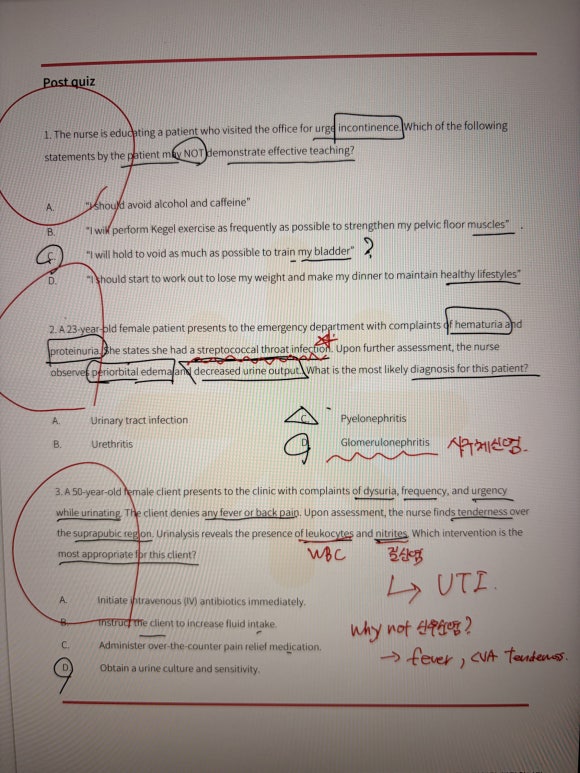
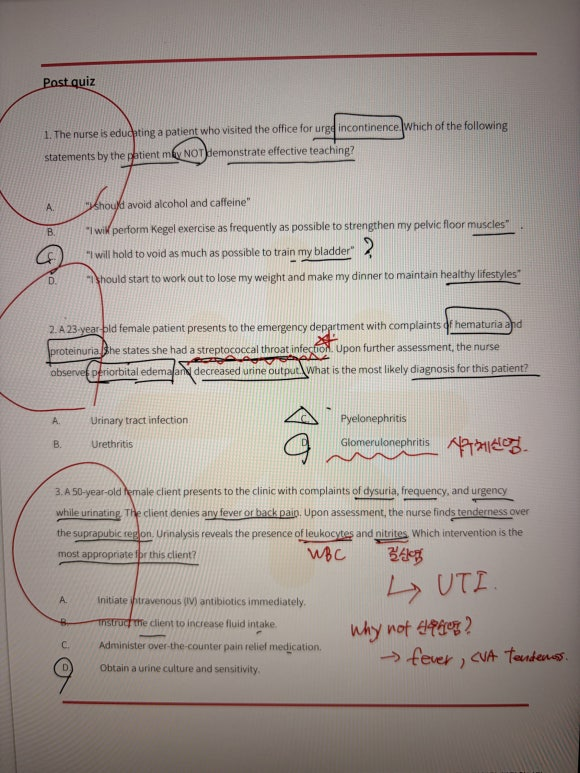
  • Pelvic floor muscle training(for urge incontinence)=(Kiegel exercises)

  • Bladder training - drink a measured amount of fluid every 2 hours. Then, attempt to void 30 minutes later; increase the time interval gradually

2. Cystitis(UTI, 방광염)

Causes

  • Infection(E.coli), chemical irritants, stones, trauma

  • Mostly result from infection originating in the urethra

Predisposing factors

Female(urethra), Increased age, Urinary catheter, DM, poor hygiene, urinary stasis

Assessment(Manifestations, 증상)

  • Urinary frequency and urgency

  • "Burning sensation"

  • Dysuria(요통) or voiding small amount

  • Suprapubic(치골상부) and back pain

  • Cloudy urine with foul smelling

  • Symptoms in older adults - confusion; children - fever, irritability

Nursing interventions

  • Obtain a urine specimen for culture and sensitivity BEFORE administering of antibiotics

  • Administer a prescribed antibiotics; anlagesics and antispasmodics

👉 Antibiotic : sulfamethoxazole-trimethoprim (Bactrim)

👉 Urinary tract analgesics(진통제)/Antispasmoic(항경련제) : phenazopyridine

  • Encourage fluid intake 3L/day

  • Maintain acidic urine(cranberry juice)

  • Avoid urinary catheter. Use aseptic technique when inserting one.

  • Application of heat to relieve pain and bladder spasm

  • Avoid urinary tract irritants such as coffee, tea, citrus, spices, coke and alcohol

  • Educate about personal hygiene : wipe front to back

  • Teach females to void before and after inercoures

3. Urethritis(요도염)

  • Commoonly occures with a sexually transmitted infection(STI)

  • In man, mostly related to gonorrhea(임질) or chlamydial infection(클라미디아 감염증)

  • In women, caused by feminine hygiene spray or UTI

Assessment(Manifestations, 증상)

  • Urinary frequency and urgency

  • "Burning sensation"

  • M : clear to mucopurulent discharge from the penis

  • F : lower abdominal pain

Nursing interventions

  • Have the patient undergo STI testing

  • Encouage fluid intake

  • Administer a prescribed antibiotics

4. Pyelonephritis(신우신염)

  • An inflammation of the renal pelvis and the kidney tissue caused by bacterial infection

  • Usually occures when bacteria(E.Coli) from the bladder ascend to the kidneys, leading to infection

  • Chronic pyelonephritis can lead to AKI or CKD

Assessment

  • fever, chills, malaise(피로감), flank(옆구리) pain

  • CVA(Costovertebral angel, 늑골척주각, 12th 늑골 부위) tenderness

  • Urinary frequency, dysuria

  • Cloudy urine with strong odor

Predisoposing factors

  • Recurrent UTI

  • Pregnancy, Tumor, obstruction

Nursing interventions

  • Bedrest during acute phase

  • Antibiotic therapy, analgesics, antispasmodic med.

  • Encourage fluid intak 3L/day

  • Moniotr V/S, I/O

  • administer renal diet (high caloric with low protein)

  • Monitor for signs of AKI or CKD

5. Glomerulonephritis(사구체신염)

  • Damage to glomerulus caused by an immunological reaction that results in proliferative(증식하는) and inflammatory changes within the glomerular structure

  • Acute glomerulonephritis

👉 Commonly caused by group A beta hemolytic streptococcal infection

    • URI(Upper respiratiory infection), skin infection

    • Occures 10 days after a skin or throat infection

    • A child with persistent URI

👉 Autoimmune disease(자가면역질환)

Assessment(Manifestations, 증상)

  • Fever, chills

  • Hematuria, red cell casts

  • Proteinuria, dark colored urine

  • Dypnea, weight gain

  • lung creackles, fluid overload

  • Generalized or periobital(눈주위) edema

  • N/V

  • Oliguria

Nursing interventions

  • Administer the following medications

    • antibiotics - to eliminate infeciton

    • corticosteroids - to alter immune reaciton to reduce infection

    • antihypertensive, diuretics

    • immunosuppressive medications(면역억제제)

  • Restrict Na+ intake ; Restrict fluid intake

  • Obtain daily weight

  • Assess I/O

  • Monitor electrolytes

  • Dialysis or plasma electrophoresis if AKI develpos

Complications : Kidney failure, Pulmonary edema, Uncotrolled hypertension, Heart failure

6. Nephrotic syndrome(신증후군)

Pathophysiology

  • Inflammation ➡️ occlusion of glomeruli and damage of endothelial cells of glomerulus

  • Glomerular dabage casues

    • Increased permeability(침투성)

    • Large loss of plasma proteins(proteinuria)

    • Decreased albumin in the body

    • Decreased oncotic pressure(단백질이 모세 혈관 내에서 발휘하는 흡수 힘, 삼투압)

    • Hypovolemia

    • Increased aldosterone & ADH

    • Na+ & water retention

    • Edema

    • Foamy urine

Assessment

  • Proteinuria ➡️ Decreased serum osmotic pressures ➡️ edema

  • Loss of immunoglobulins(proteins)

  • Increased risk infection

  • Loss of proteins for hormones

  • Hypothyrodism

  • Hyperlipidemia

  • Foamy urine

Dx

24-hour urine for protein

Med

Corticosteroid therapy, Immunosuppressant therapy, diuretics

Nursing interventions

  • Monitor V/S, urine output, edema and daily weight

  • Monitor signs of incfection

  • Monitor urine for protein and specific gravity

  • Diet- Low cholesterol diet, sodium restriction

7. Renal calculi, Urinary catheter / Urinary diversion

Causes

Hypercalcemia, dehydration, immobility, gout(통풍), increased intake of oxalate(spinach, peanuts, chocolate, avocado)

Dx

IV pyelogram(신우조영도), renal ultrasound, X-ray of KUB

Assessment

  • Sharp, severe pain with sudden onset

  • Pain - depending on location of stone

    • Renal calculi ➡️ flank pain

    • Ureter or bladder stone ➡️ radiating flack pain(방사통)

  • N/V, Diaphoresis(발한)

  • Hematuria, WBCs and bacteria in the urine

  • Fever and chills

Nursing interventions

  • Patient education

    • Diet for prevention of stone - most stones contain calcium, phosphorus or oxalate

    • Avoid milk, cheese, dairy products(유제품)

    • Avoid oxalates(spinach, coke, tea, chocolates)

    • Avoid purine sources(uric acid- organ meat)

  • Administer antibiotics, thiazide diuretics, orthophosphate, sodium cellulose phosphase, allopurinol

Treatment

Cystoscopy, ureteroscopy, ESWL, Percutaneous lithotripsy

Surgery

Ureterolithotomy, Pyelolithotomy, Nephrolithotomy, Nephrectomy

출처 https://blog.naver.com/hips13/224258058678